
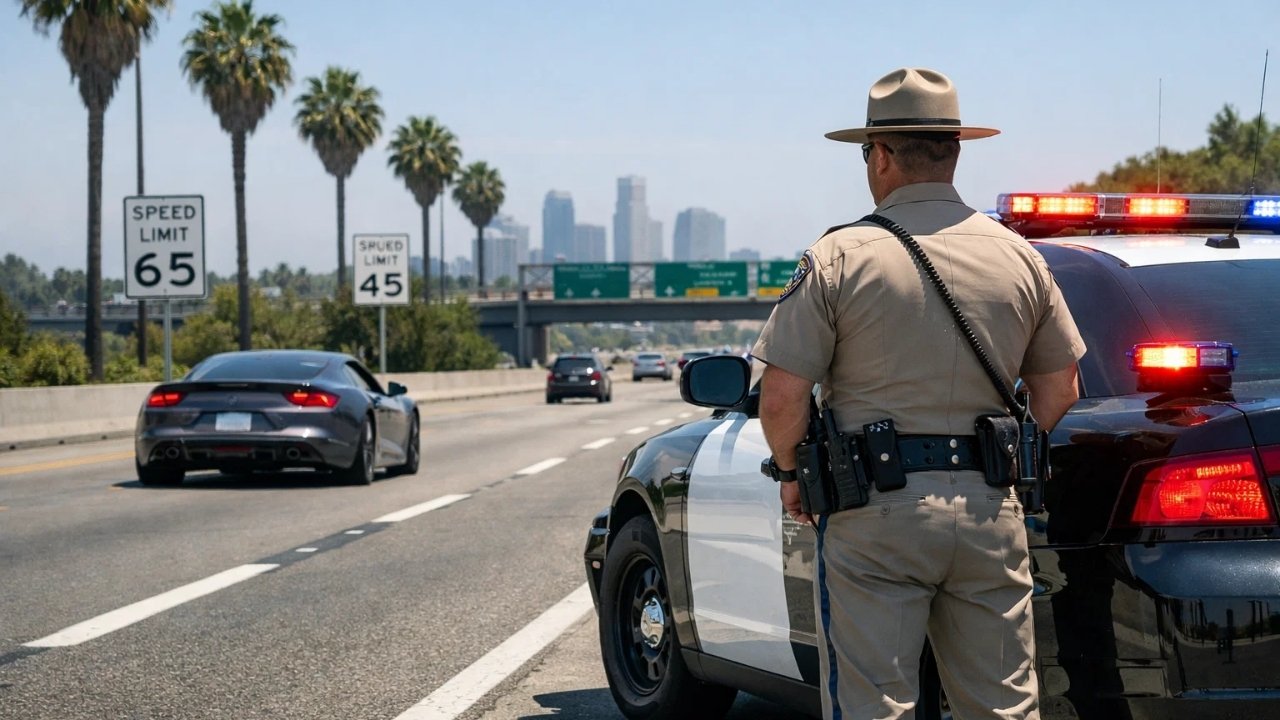
California has introduced a new system to more quickly address drivers caught going well over the posted speed limits on its highways. For years, authorities relied on traditional processes that often took weeks or months before a speeding case could lead to meaningful consequences. With an increasing number of drivers clocking speeds over 100 miles per hour, officials concluded that the existing approach was too slow to effectively deter dangerous driving.
The new initiative, known as the Forwarded Actions for Speeding Tickets (FAST) pilot program, represents a collaborative effort between the California Department of Motor Vehicles (DMV) and the California Highway Patrol (CHP). Rather than handling extreme speeding cases through the standard court calendar, FAST is designed to move these cases directly to administrative review by the DMV. This change was made to reduce delays between the moment a driver is cited and when action can be taken against their license.
The decision to launch FAST reflects broader concerns about rising traffic dangers on California roads. Recent enforcement data show that thousands of drivers each year exceed 100 mph, prompting officials to adopt more immediate strategies to improve highway safety.
Table of Contents
Why California Adopted the FAST Program
California has long battled serious traffic incidents linked to excessive speed. According to transportation authorities, speeding contributes to a significant percentage of fatal crashes across the state. High speeds reduce a driver’s reaction time and increase the force of impact when crashes occur, raising the risk of severe injuries or death.
Traditional handling of speeding citations relied heavily on court proceedings, which can be slow and backlogged. During that delay, drivers cited for extreme speeding often continued driving with few immediate consequences, weakening the deterrence effect of citations.

To address this gap, California officials determined that earlier intervention by the DMV could help remove the most dangerous drivers from the road more rapidly. The FAST program is structured so that every citation for driving over 100 mph is automatically sent to the DMV’s Driver Safety Branch for administrative review. This process operates independently of any later court decision.
Under FAST, the DMV considers both the specific speeding incident and the driver’s record to decide whether to suspend or revoke driving privileges. This change aims to act sooner than the traditional system, which often waits for a judicial resolution before considering license action.
⚠️ California is cracking down on extreme speeding. Under a new CalSTA pilot, any CHP citation over 100 mph is automatically sent to the DMV for review, which may lead to license suspension or revocation. Speeding causes nearly 1/3 of traffic deaths. Slow down—lives depend on it! pic.twitter.com/KVdR0pKlXu
— CHP Headquarters (@CHP_HQ) December 23, 2025

How FAST Works: Administrative Review Instead of Waiting
Under the FAST pilot, once a driver is cited by a CHP officer for traveling more than 100 mph, the citation is no longer handled first by a prosecutor or through a long court schedule. Instead, it goes straight to the DMV’s Driver Safety Branch for review.
The Driver Safety Branch looks at details of the citation as well as the driver’s previous record to determine if an administrative action is appropriate. Depending on the case, this action can include suspension or revocation of the driver’s license. Unlike the typical process, this administrative review does not require a court conviction before action is taken.
This means that drivers face DMV review even if it is their first serious speeding offense and regardless of whether the matter has been heard in court. The idea is to reduce the time between being caught and facing consequences, with the goal of preventing additional high-speed incidents while the case is pending.
Officials state that this system builds on existing partnership efforts between the DMV and CHP, including the Negligent Operator Treatment System (NOTS), but adds greater speed and certainty to enforcement actions.
Speeding Data: How Often Extreme Speeds Occur
California authorities regularly compile data on enforcement activities related to high speeds. Below is an overview of the most recent numbers showing how frequently drivers exceed 100 mph and enter the FAST process:
| Statistic | Value |
|---|---|
| Average citations issued per month for >100 mph | ~1,600 |
| Total citations issued in 2024 for >100 mph | >18,000 |
| Approximate citations per day | ~50 |
These figures demonstrate that extreme speeding is not rare on California highways, averaging around 50 drivers per day who receive citations for driving over 100 mph. Officials view this frequency as a primary reason for changing how these cases are handled.
Legal Context: How California Has Treated Extreme Speeding
Under California law, driving faster than 100 miles per hour has long been considered a serious traffic violation. Before FAST, drivers caught at these speeds faced fines and potential license suspension through the court system. The Vehicle Code (e.g., Section 22348(b)) traditionally allowed courts to impose fines ranging from several hundred dollars to additional license suspensions of days or more, and also assessed points on a driver’s license.
However, the new FAST program adds a parallel administrative path that operates separately from courts. The DMV’s Driver Safety Branch can act on its own authority to limit driving privileges without waiting for a court outcome, making the overall enforcement process quicker and more direct.
This doesn’t remove the court process entirely; drivers can still face fines, court appearances, and legal consequences in addition to administrative action by the DMV. Rather, FAST ensures the DMV can act on a high-speed citation in advance of or alongside those traditional procedures.
Looking Ahead: Monitoring and Evaluation
Since FAST is a pilot program, California agencies plan to monitor its results carefully. The DMV will compare data from the pilot period against previous years to determine whether the program reduces repeated extreme speeding or related crashes.
Officials have noted that the initiative supports the state’s broader Policy on Road Safety, which targets reducing serious injuries and fatalities tied to vehicle speed and other risk factors.
Future decisions on whether to expand FAST or adjust its criteria will likely depend on this evaluation. As with many pilot programs, success is measured by measurable improvements in public safety outcomes over time.