
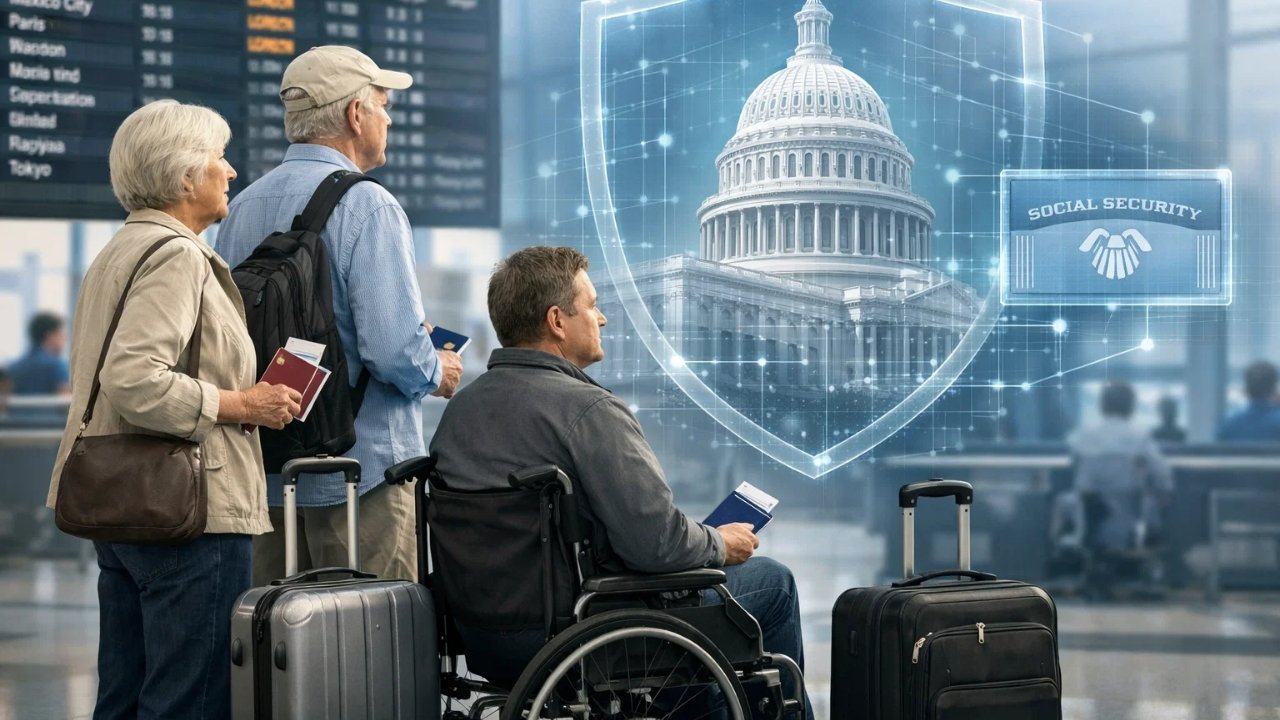
The U.S. government has formally approved a rule that allows the Social Security Administration (SSA) to expand how it collects and shares personal and travel-related data of millions of Social Security recipients with other federal agencies, especially the Department of Homeland Security (DHS). This change is part of an updated “System of Records Notice”, which defines how government databases can be used and shared legally.
This rule does not create a brand-new travel restriction. Instead, it strengthens and formalizes data sharing about beneficiaries’ citizenship status, immigration status, and periods of travel outside the United States. According to government records, SSA will now share information with DHS agencies such as Immigration and Customs Enforcement (ICE) and Customs and Border Protection (CBP) for verification and enforcement purposes.

The policy affects recipients of Social Security Retirement benefits, Social Security Disability Insurance (SSDI), and Supplemental Security Income (SSI). These programs together serve more than 71 million Americans as of 2024, according to SSA statistics.
Table of Contents
Legal Basis of the Rule and Government Authority
The rule is grounded in the Privacy Act of 1974, which allows federal agencies to collect and share personal data if they publish a formal notice explaining how the data will be used. SSA’s updated SORN expands the categories of “routine uses” for its records, including sharing them with DHS for identity verification, immigration enforcement, and eligibility confirmation.
The SSA stated that the purpose of this change is to ensure that benefit payments go only to individuals who meet legal eligibility requirements, including lawful presence and residency rules. DHS can now cross-check SSA records with border and immigration databases such as the Arrival and Departure Information System (ADIS).

This formalizes cooperation that had already existed in limited form but was not previously detailed in a single legal framework.
Existing Travel Reporting Rules for Social Security Recipients
Under SSA policy, beneficiaries who leave the United States for more than 30 consecutive days must notify the Social Security Administration. This rule has existed for decades and applies mainly to SSI recipients and some non-citizen beneficiaries.
For SSI recipients, payments stop after 30 days outside the U.S. and resume only after returning and staying in the country for at least 30 days. For Social Security retirement and SSDI recipients, payments may continue abroad depending on citizenship and destination country.

SSA already tracks this information through self-reporting and passport or immigration records. The new rule connects this information more directly with DHS systems.
What Data Is Now Being Shared Between Agencies
The updated rule allows SSA to share the following categories of data with DHS:
- Full name and Social Security number
- Citizenship and immigration status
- Benefit type and payment status
- Travel and residency indicators
- Address and identity verification data
This data may be used by DHS to confirm whether individuals receiving benefits are lawfully present in the U.S. and whether they continue to meet eligibility rules related to residency and immigration law.
The SSA clarified that the rule does not authorize real-time GPS tracking or physical surveillance. It concerns administrative records, not location tracking technology.
Scale of the Population Affected
As of 2024, more than:
- 52 million retirees receive Social Security retirement benefits
- 8.8 million disabled workers receive SSDI
- 7.4 million people receive SSI
A subset of these recipients are non-citizens or individuals who travel internationally for extended periods. The rule directly affects those whose immigration status or foreign travel may influence eligibility.
According to SSA data, roughly 700,000 beneficiaries live abroad while receiving Social Security payments. These cases are most likely to be reviewed under the new data-sharing framework.
How the Rule Changes Enforcement and Monitoring
Before this rule, SSA mainly relied on beneficiaries to report travel and residency changes. DHS had limited direct access to SSA benefit records. Now, DHS can cross-reference SSA data with border entry and exit records.
This means if a beneficiary stays outside the U.S. beyond permitted time limits, DHS systems may flag this information, which can then be shared back with SSA for benefit review. This creates a closed verification loop between benefit records and travel records.
The government states this process is designed to reduce improper payments and strengthen benefit integrity programs.
Impact on Benefit Eligibility and Payments
Eligibility for Social Security and SSI depends on several factors, including residency, citizenship, and lawful presence. For SSI recipients, federal law prohibits payments while outside the U.S. for more than 30 days.
For SSDI and retirement recipients, payments can continue in many countries, but not all. SSA maintains a list of restricted countries where payments cannot be sent due to U.S. law or banking rules.
Under the new rule, incorrect or missing travel reporting could result in:
- Temporary suspension of payments
- Requests for documentation
- Benefit overpayment determinations
- Recovery of funds paid during ineligible periods

Administrative Process for Beneficiaries
SSA requires beneficiaries to report travel plans either by contacting SSA directly or through online accounts. Beneficiaries may be asked to provide proof of return to the U.S. if payments were paused.
With DHS now having broader access to SSA data, mismatches between travel records and SSA reports can trigger automatic review cases. This increases the importance of accurate and timely reporting.
SSA emphasizes that this rule does not change benefit amounts or eligibility criteria, only how information is verified and shared.
Privacy and Data Protection Framework
SSA and DHS state that data sharing must comply with federal privacy laws. The Privacy Act requires agencies to limit data use to approved purposes and publish public notices describing those uses.
The rule specifies that information can only be used for:
- Eligibility verification
- Immigration enforcement
- Fraud prevention
- Identity confirmation
The agencies are required to implement cybersecurity protections and restrict access to authorized personnel only.
What Beneficiaries Should Do Now
Beneficiaries should review SSA travel and residency rules carefully, especially if they plan to leave the United States for more than 30 days. They should ensure that their SSA records are accurate and up to date.
Keeping copies of travel documents and responding promptly to SSA inquiries can prevent benefit interruptions. SSA recommends using official communication channels and not relying on third-party interpretations.
This rule does not require beneficiaries to change daily behavior but does require stronger compliance with existing travel reporting obligations.