
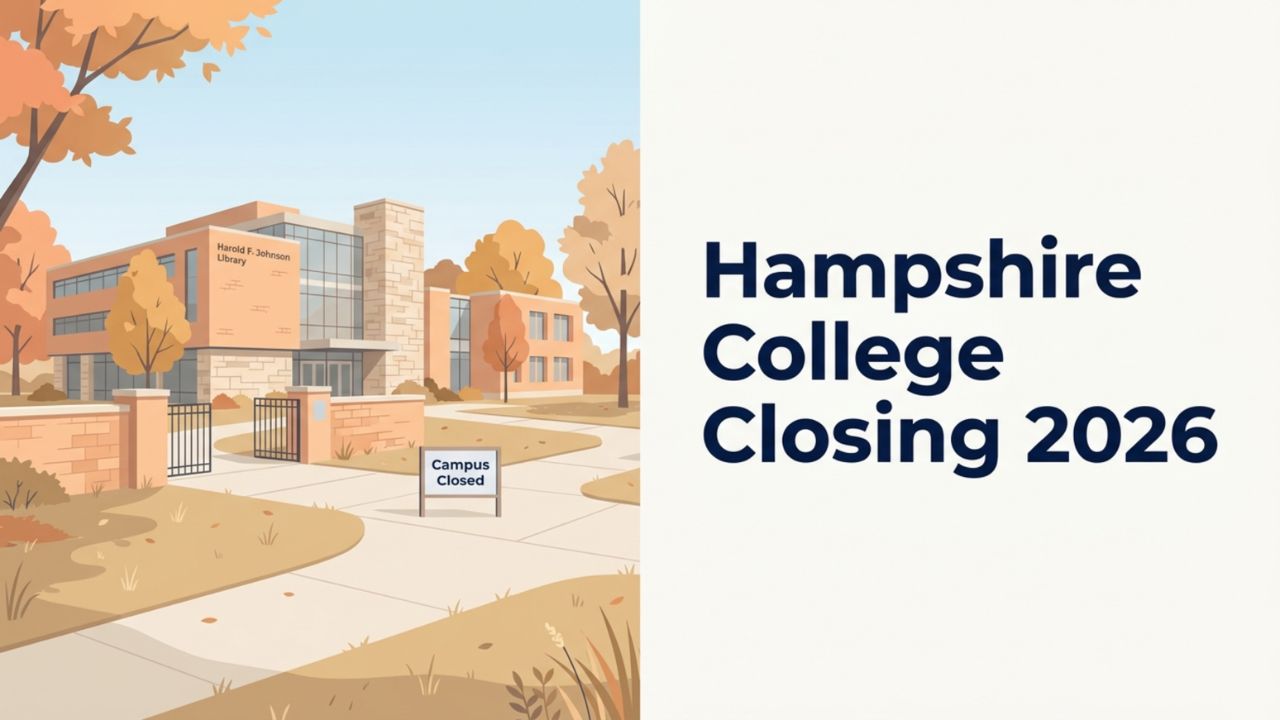
In a major development in U.S. higher education, Hampshire College has officially confirmed that it will shut down operations permanently after the Fall 2026 semester. The announcement has raised concerns across the academic community, especially among students, faculty, and alumni connected to the institution.
Table of Contents
Closure Announcement and Timeline
Hampshire College has stated that it will continue academic operations until the end of Fall 2026, after which the campus will close permanently. The decision was approved by the Board of Trustees following months of financial review and planning.
Students currently enrolled will be allowed to complete their academic programs under a structured transition plan. However, the college will not admit new students for the Fall 2026 intake, signaling a clear phase-out approach.
Graduation ceremonies for final batches are expected to take place as scheduled, ensuring that current students are not left without formal recognition of their degrees.
Hampshire College in Amherst, Massachusetts, will close after the 2026 fall semester, becoming at least the sixth university this year to announce plans to shutter or be acquired https://t.co/RKYlPK5WoP
— Bloomberg (@business) April 14, 2026
Reasons Behind the Decision
The closure comes after years of mounting financial pressure. Like many small liberal arts institutions, Hampshire College has faced significant challenges in maintaining stable enrollment numbers and managing operational costs.
Over time, the institution experienced a steady decline in student admissions, which directly impacted tuition revenue—its primary funding source. At the same time, increasing costs related to staffing, infrastructure, and student services created additional strain.
Despite exploring partnerships, fundraising efforts, and restructuring plans, the administration concluded that continuing operations was no longer financially viable. This marks the end of a prolonged struggle that had already brought the college close to closure in previous years.
Support Plan for Current Students
To ensure that students are not adversely affected, the college has introduced a detailed transition strategy.
The focus is on allowing students to either complete their degrees on campus or transfer smoothly to other institutions. Several well-known colleges within the Five College Consortium have agreed to support this process.
Key Support Measures
- Students nearing graduation can complete their programs by Fall 2026
- Transfer pathways are being arranged with nearby institutions
- Academic records and credits will be facilitated for smooth transitions
- Counseling and advising services will continue during the transition period
Institutions such as Amherst College, Smith College, Mount Holyoke College, and University of Massachusetts Amherst are expected to play a key role in accommodating transferring students.
Legacy of the Institution
Founded in 1965, Hampshire College was widely recognized for its innovative and student-driven academic model. Unlike traditional institutions, it emphasized interdisciplinary learning and narrative evaluations instead of conventional grading systems.
Over the decades, the college built a reputation for encouraging independent thinking and creative academic exploration. It also became a significant part of the Five College Consortium, collaborating closely with neighboring institutions to offer a broader academic experience.
The closure marks the end of an institution that played a unique role in shaping alternative education in the United States.
Impact on the Higher Education Sector
The decision reflects a growing trend affecting smaller colleges across the country. Rising costs, demographic shifts, and changing student preferences are putting pressure on institutions that rely heavily on tuition revenue.
Experts believe that more colleges with limited financial reserves may face similar challenges in the coming years. The case of Hampshire College highlights the urgent need for sustainable funding models and strategic planning in higher education.