
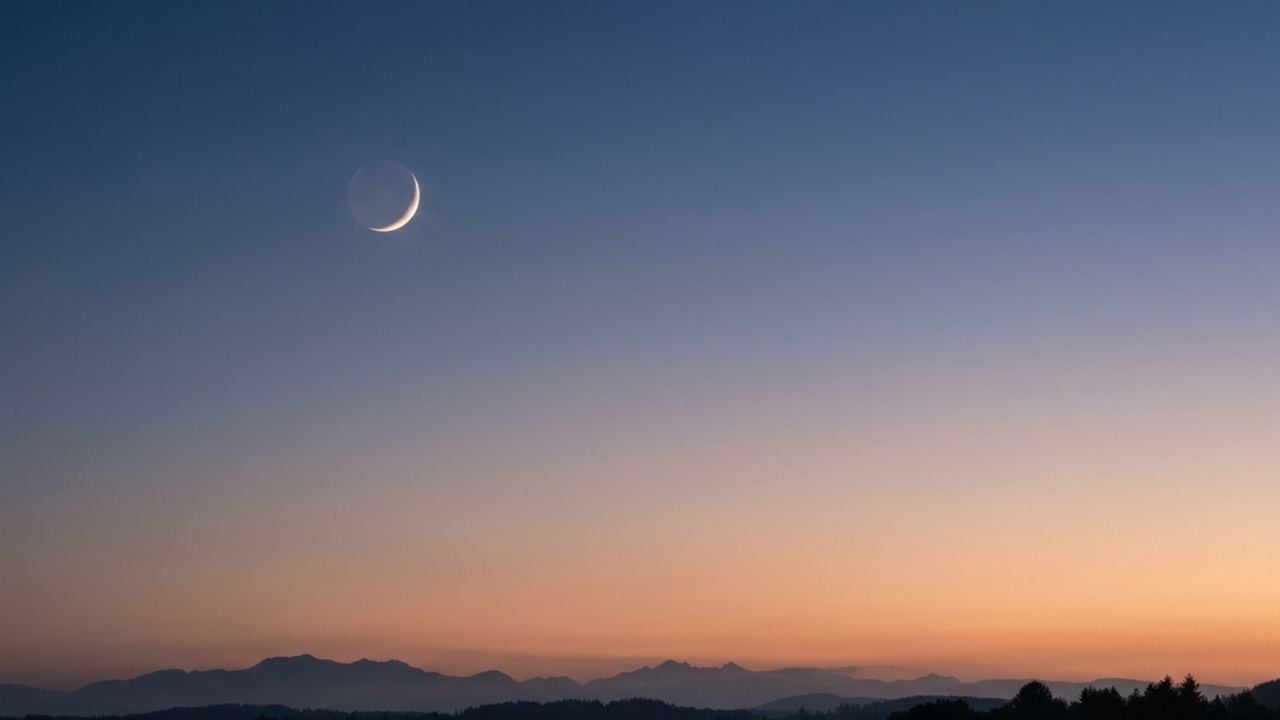
The Moon enters a new lunar cycle this week, and skywatchers will notice a subtle but important transition in the evening sky. Just a day after the New Moon, April 18, 2026, brings the first visible appearance of the Moon in its early phase.
This stage is often overlooked due to its faintness, but it marks the beginning of the Waxing phase. For observers across India, including northern regions like Himachal Pradesh, the Moon will appear briefly after sunset as a delicate crescent.
Table of Contents
Current Moon Phase on April 18
On April 18, 2026, the Moon is in the Waxing Crescent phase, which begins immediately after the New Moon phase observed on April 17.
At this stage, the Moon has just started reflecting sunlight again, with only about 1% illumination. This makes it one of the faintest visible lunar appearances in the monthly cycle. The next major phase, the First Quarter Moon, is expected on April 24, when half of the Moon will be illuminated.
What the Moon Will Look Like
The Moon will appear as a very thin, curved sliver in the sky. Its shape resembles a narrow arc, with the illuminated edge pointing away from the Sun.
Due to its extremely low illumination, the Moon may look faint and can be difficult to spot without a clear view of the western horizon. Under ideal conditions, observers may also notice earthshine, where the darker portion of the Moon is faintly visible due to sunlight reflected from Earth.
This phase is visually subtle but scientifically significant, as it represents the transition from complete darkness to gradual illumination.
Visibility in India: Time and Position
For most parts of India, including Shimla and nearby regions, the Moon will be visible only for a short duration after sunset.
The approximate observation window is:
- Sunset: Around 6:45 PM – 7:00 PM
- Moonset: Around 8:00 PM – 8:15 PM
This creates a narrow viewing window of roughly 60 to 90 minutes after sunset. During this time, the Moon will remain low in the western sky, making an unobstructed horizon crucial for visibility.
Skywatching Conditions and Alignment
April 18 offers an added visual interest beyond the Moon itself. The thin crescent may appear in proximity to bright evening objects like Venus, enhancing the overall sky composition.
However, visibility depends on:
- Clear skies with minimal haze or pollution
- Low light interference from urban areas
- An open western horizon without hills or buildings
Because the Moon is so thin, even slight atmospheric conditions can make it difficult to detect.
Why This Phase Matters
The Waxing Crescent phase signals the start of the lunar growth cycle, where the illuminated portion increases each day. While it may not be as visually striking as a Full Moon, it is crucial for tracking lunar progression and is often used in calendars and observational astronomy.
For enthusiasts and photographers, capturing this early crescent is considered a rewarding challenge due to its brief visibility and delicate appearance.
On April 18, 2026, the Moon will appear as a slender waxing crescent, marking the first visible phase after the New Moon. It will be visible shortly after sunset, low in the western sky, and will remain faint and short-lived.
Despite its subtle presence, this phase represents the beginning of a new lunar cycle and offers a unique opportunity for careful sky observation.