
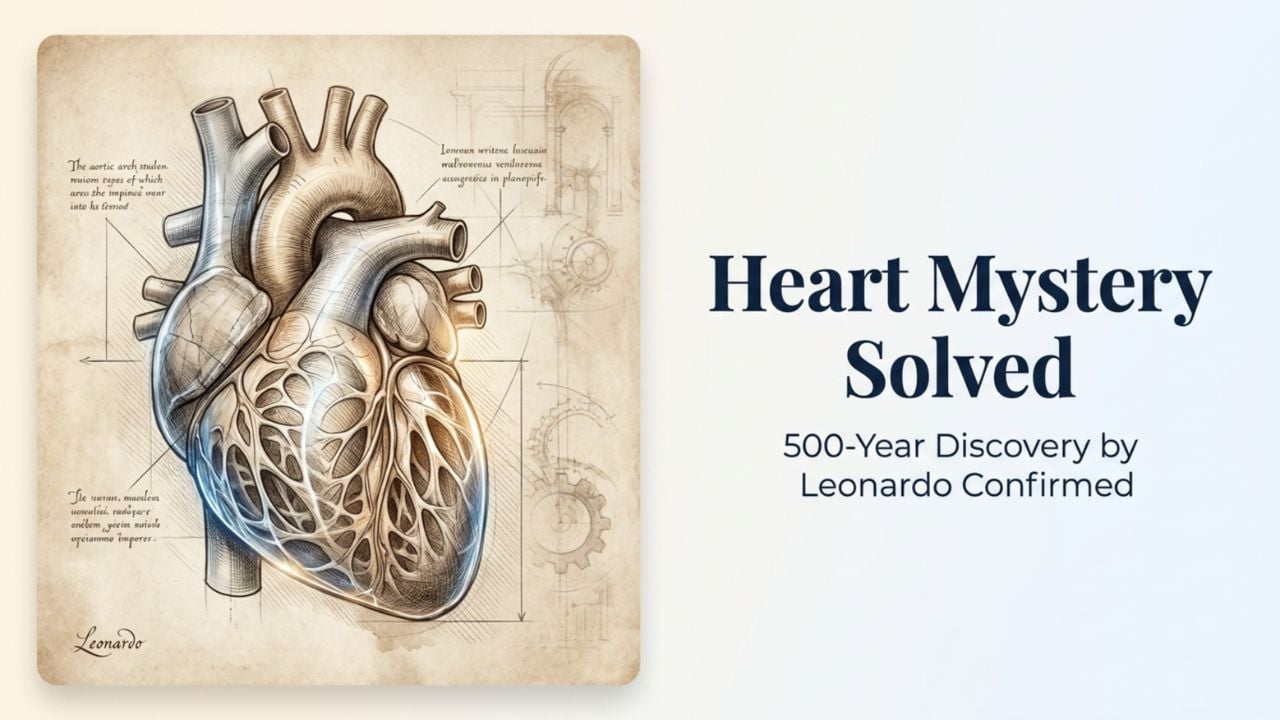
The human heart has long been one of the most studied organs in medical science, yet certain structural features remained poorly understood for centuries. One such feature is the intricate mesh-like pattern inside the heart, first carefully documented by Leonardo da Vinci more than 500 years ago.
Recent scientific findings, suggest that this structure, once a mystery even to Leonardo, plays a significant role in heart function and disease risk. The study brings together historical anatomy and modern biomedical research in a compelling way.
Table of Contents
What Leonardo da Vinci Observed in the Human Heart
During the early 16th century, Leonardo conducted detailed dissections and produced remarkably accurate drawings of the human heart. Among his most notable observations was the presence of complex muscular ridges lining the inner walls of the ventricles.
These structures, now known as trabeculae, appeared as branching, web-like formations. Leonardo’s illustrations captured their intricate geometry with striking precision, far beyond the anatomical understanding of his time.
However, while he correctly documented their structure, he could not fully determine their function. He speculated that these formations might help warm the blood, an idea that modern science has since disproven.
Understanding Trabeculae: The Heart’s Inner Network
Trabeculae are muscular strands that form a network inside the ventricles of the heart. For decades, scientists believed these structures were primarily important during early development and had limited significance in adult heart function.
Modern imaging techniques, particularly cardiac MRI, have revealed that these patterns are far more complex than previously thought. Their arrangement follows a fractal-like design, meaning similar patterns repeat at different scales.
This discovery shifted the perception of trabeculae from passive structures to active contributors in cardiac mechanics.
Breakthrough Research: What Modern Science Found
A major turning point came with a large-scale study published in the academic field of Cardiology. Researchers analyzed tens of thousands of heart scans using advanced computational tools.
The study examined data from over 18,000 individuals using fractal analysis, while broader datasets extended to nearly 25,000 MRI scans. This allowed scientists to measure trabecular complexity with high precision.
The findings showed that the structure of trabeculae directly influences how efficiently the heart pumps blood. Instead of being redundant, these formations help optimize blood flow within the ventricles.
How Trabeculae Improve Heart Function
One of the most important insights from the study relates to fluid dynamics inside the heart. The rough, textured surface created by trabeculae appears to reduce resistance to blood flow.
Researchers often compare this effect to the dimples on a golf ball, which help air move more efficiently around its surface. Similarly, trabeculae help maintain smoother and more controlled blood movement during each heartbeat.
This improved flow efficiency can enhance overall cardiac performance, especially under physical stress or increased demand.
Genetic Link and Disease Risk
The study also explored the genetic basis of trabecular patterns. Scientists identified multiple genomic regions associated with how these structures develop and vary among individuals.
Interestingly, some of these genetic markers are also linked to the development of other branching systems in the body, such as nerve cells. This suggests a deeper biological connection between structure and function.
More importantly, variations in trabecular complexity were associated with different risks of heart-related conditions, particularly heart failure. Individuals with certain structural patterns showed a higher predisposition to cardiac dysfunction.
Why This Discovery Matters Today
This research provides a clearer understanding of how micro-level heart structures influence macro-level health outcomes. It opens new possibilities for early diagnosis and risk assessment in cardiovascular diseases.
Medical professionals may eventually use trabecular patterns as a biomarker to evaluate heart health more precisely. This could lead to improved screening methods and more personalized treatment strategies.
From a historical perspective, the findings also reinforce the depth of Leonardo’s anatomical insights. While he lacked modern tools, his observations laid the groundwork for discoveries that would only be confirmed centuries later.
The renewed focus on the heart’s trabecular network highlights how science often builds on observations made long ago. Leonardo da Vinci identified a structural feature that remained unexplained for centuries, and modern research has now clarified its significance.
The convergence of historical anatomy and advanced medical technology underscores a broader reality: even the most familiar organs can still hold unexplored complexities. This discovery not only advances cardiovascular science but also reaffirms the enduring relevance of early scientific inquiry.